
IoT
IoT is short for Internet of Things and refers to the ever-growing network of physical objects.
Timely Service Delivery & Incident Resolutions!!
IoT provides businesses with a real-time look into how their systems really work, delivering insights into the performance of machines, supply chain and logistics operations.
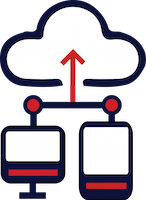
IoT is short for Internet of Things and refers to the ever-growing network of physical objects that feature an IP address for Internet connectivity, and the communication that occurs between these objects and other Internet-enabled devices and systems.
The Internet of Things extends internet connectivity beyond traditional devices like desktop and laptop computers, smartphones and tablets to a diverse range of devices and everyday things that utilize embedded technology to communicate and interact with the external environmentr, all via the internet.
Key benefits of Internet of Things:
- Businesses can use advanced IoT analytics for advantages such as improved efficiency and productivity and reduced costs.
- The IoT is producing new business opportunities through innovation as well as by redefining traditional business operation models.
- Customer experience is key for increased revenue and IoT provides ways to track customer behaviors for maximum impact.
- Businesses should safeguard data flowing to and from IoT devices for optimal security and to avoid halts in service.

Internet of Things
IoT services comprise strategic consulting, development, data analytics, and application management aimed at helping organizations solve their business challenges and tap in new revenue streams via IoT technology. REDEXPER offer full-range IoT services and help organizations work out reliable and cost-effective ways of addressing their business challenges and tech obstacles with IoT technologies.
Business uses for IoT include keeping track of customers, inventory, and the status of important components. IoT flags four industries that have been transformed by IoT:
Oil and gas: Isolated drilling sites can be better monitored with IoT sensors than by human intervention
Agriculture: Granular data about crops growing in fields derived from IoT sensors can be used to increase yields
HVAC: Climate control systems across multiple locations can be monitored by manufacturers
Brick-and-mortar retail: Customers can be microtargeted with offers on their phones as they linger in certain parts of a store
Cost Reduction
Maintenance costs can be positively impacted when IoT devices are used with sensors to keep business equipment running at peak efficiency. On-the-fly troubleshooting of office equipment catches problems before they impact the employees, saving you the costs of large repairs.
Efficiency & Productivity
In the work environment, IoT can be used to optimize an office floor plan and mobilize company resources—like copiers, printers, and WiFi bandwidth—for a better workflow and a more streamlined and effective approach to management.
Customer Experience
While IoT technology has so far mostly influenced back-end processes because of its relatively new presence, today’s IoT has meant that omni-channel strategies have completely upended the way consumers approach their relationships with businesses.
Mobility & Agility
Remote workers have become an integral part of modern workforces. Utilizing IoT technology across all your devices for communication purposes, as well as using a strategy for securing those endpoints, will be primary concerns for any initiatives making use of Iot.
Advanced technology solutions utilizing IoT tech can help companies achieve and maintain a competitive advantage in their industry. Through leveraging the tools available, you can increase staff productivity and decrease costs—your business can enjoy higher operating capacity and deliver a superior customer experience.
Internet of Things
Frequently asked questions
The Internet of Things refers to the network of things (physical objects) that can be connected to the Internet to collect and share data without human-to-human or human-to-computer interaction.
The term Internet of Things was coined by Kevin Ashton in 1999.
Stemming from Kevin Ashton’s experience with RFID, the term Internet of Things originally described the concept of tagging every object in a person’s life with machine readable codes. This would allow computers to easily manage and inventory all of these things.
The term IoT today has evolved to a much broader prospect. It now encompasses ubiquitous connectivity, devices, sensors, analytics, machine learning, and many other technologies.
An IoT solution is a combination of devices or other data sources, outfitted with sensors and internet connected hardware to securely report information back to an IoT platform. This information is often a physical metric which can help users answer a question or solve a specific problem.
An IoT platform provides users with one or more of these key elements — visualization tools, data security features, a workflow engine and a custom user interface to utilize the information collected from devices and other data sources in the field. Cloud platforms are based in the cloud and can be accessed from anywhere.
An application enablement platform is an IoT platform that provides developers with the tools to quickly build a working application and user interface with very little code. AEPs allow organizations to scale faster and gain value from IoT investments faster by removing technology hurdles.
Edge computing is a method which enables devices to process data at or near where it is collected instead of sending it to a data center or to the cloud. Edge computing is used to achieve local optimized control, operate in spite of intermittent connectivity or immediately filter data, sending only what is necessary to the cloud.
Industrial equipment monitoring uses a network of connected sensors - either native to a piece of equipment or retrofitted - to inform owners/operators of a machine’s output, component conditions, need for service or impending failure. Industrial equipment monitoring is an IoT solution which can utilize an IoT platform to unify disparate data and enable decision makers to respond to real-time data.
Condition-based maintenance or CBM is a method of proactive maintenance which enables owners to respond to conditions only when a need arises. Conditions of machine components are monitored using IoT (sensors, a network connection and gateways).
Predictive maintenance refers to a method of maintenance created using IoT that relies on data from a combination of sources including machine components and other indicators which inform an owner/operator of the items requiring attention before any service interruption occurs. Predictive maintenance often requires a large supply of historical data in order to function appropriately.
You can always reach us on our phones, our teams are available around the clock for any questions you may have.

Need Our Help? You Are More Than Welcome To Visit Us Or Give Us A Call
REDEXPER has been helping organizations and Providers through South East Asia manage their IT with our unique approach to technology management and consultancy solutions.
Kuala Lumpur Office
- L21-06, PJX HM Shah Tower, 16 A, Jalan Persiaran Barat, Pjs 52, 46200, Petaling Jaya, Selangor Darul Ehsan, Malaysia
- Phone: +603 7931 6320
- Mobile: +6012 648 2701
- Hours: Mon-Fri: 8am – 7pm
Singapore Office
- 22 Sin Ming Lane, #06-76 Midview City, Singapore 573969,
Singapore - Phone: +6589222041
- Hours: Mon-Fri: 8am – 7pm